
The journey of constructing the MAC workshop.
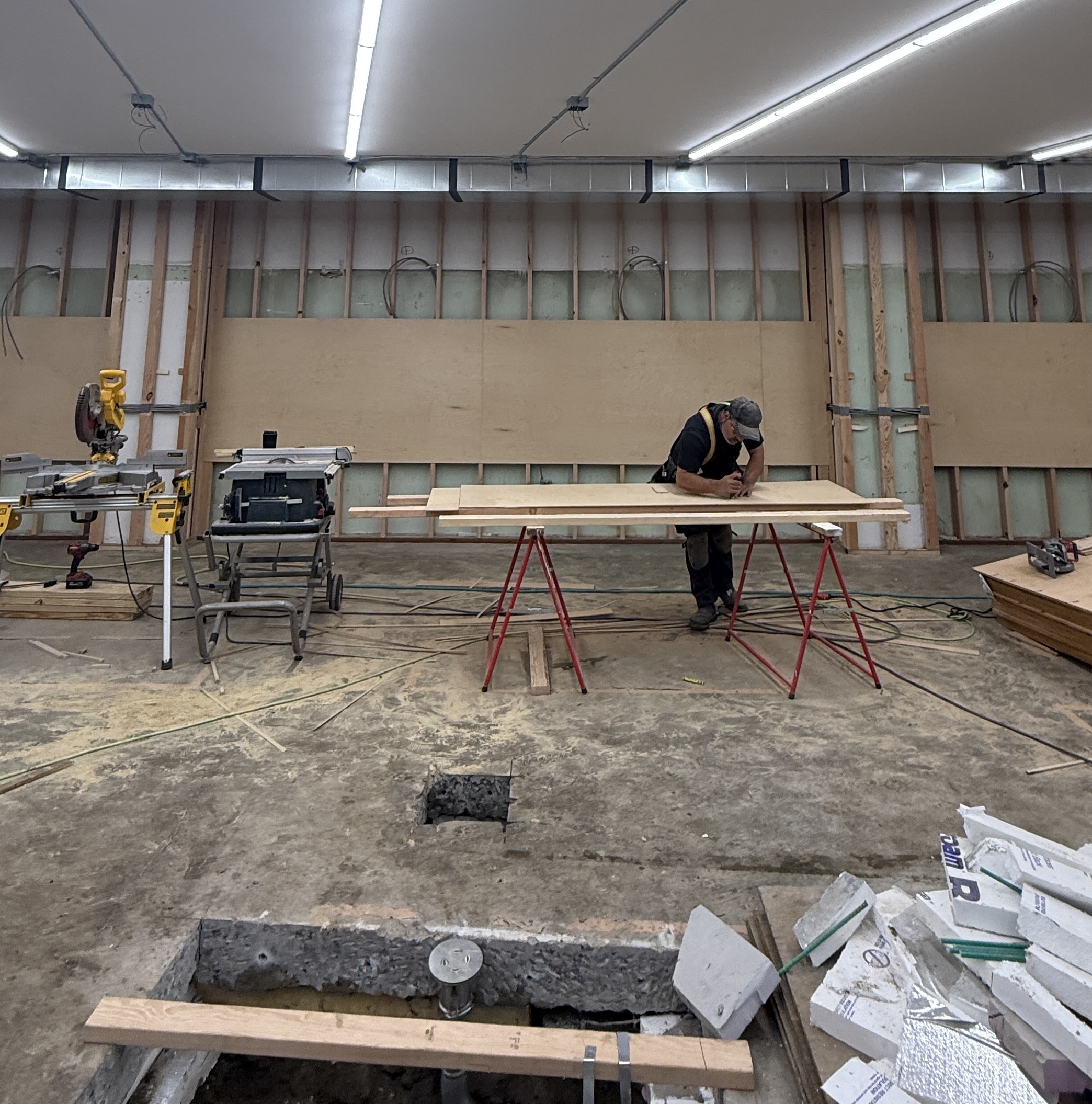
When people walk into Mayest Arts Collective for the first time, what they’ll see is a finished space: lights, HVAC, tools, work tables, rooms that feel intentional and welcoming. What they won’t see is everything it took to get the building to that point. This post isn’t a technical construction log or a highlight reel. It’s a record of process. Of disruption, delays, problem-solving, and the kind of learning that happens when you’re building something real inside a space that keeps reminding you it has a history of its own.
When we first got the keys, the space was not something you could imagine teaching in. Extremely sketchy electrical “improvements,” old plumbing, asbestosy tiles. It had to be gutted completely. Walls came down. Old infrastructure was removed. What remained was a shell: concrete, studs, unknowns. That moment, standing in a stripped-down building, set the tone for everything that followed. There was no illusion anymore that this would be quick or clean. It was clear from the start that we’d be uncovering more than we planned for. One of the earliest and most significant steps was trenching through the concrete slab to build two ADA-accessible bathrooms. Accessibility wasn’t optional or something to “add later.” It had to be quite literally built into the foundation. That meant cutting into the slab, removing material, and reworking systems that hadn’t been touched in decades. Trenching is loud, messy, and unforgiving work so, before we began any of that, we had to build a sound-proof wall between us and our extremely patient neighbors.
Around the same time, we began trenching for dust collection. A functional shop depends on safe, effective dust management, and we decided that infrastructure should live below the surface – a decision we’d soon regret. As the slab was opened up further, we discovered something no one had anticipated: the building had been constructed on top of an old peat bog. Old timber pylons punctured the void we found under the decades old slab. Instead of stable ground, we found organic material that shifted, held moisture, and changed the assumptions about what the building was sitting on.
Finding a peat bog under your slab is the kind of surprise that forces a pause. It’s not just an engineering issue (which triggered its own weeks long re-re-review of our plans), it’s a reminder that buildings are layered over landscapes with their own histories. The ground beneath Mayest wasn’t neutral or inert. It had memory. That discovery shaped decisions moving forward, slowed timelines, and added complexity where simplicity had been hoped for. Not long after, we hit another setback, this one more human, but no less disruptive. The wrong floor was delivered. Not a small mismatch or a few incorrect boxes, but an entirely wrong product. It was nearly fully installed before the mishap was discovered. At that point, there was no choice but to rip it all out.
Anyone who has worked in construction knows this kind of moment. The work is done, the space looks closer to finished than it ever has, and then suddenly everything reverses. Flooring had to be removed, adhesives cleaned up, surfaces restored, and schedules reworked. It was physically exhausting and emotionally deflating. Progress, which had felt tangible, slipped backward.
As if that weren’t enough, our cabinet maker’s shop flooded during the recent flooding. Work that was happening off-site, critical work we were relying on, was suddenly stalled. Materials were damaged. Timelines shifted again. People who were already stretched thin had to deal with cleanup and recovery before they could even think about returning to our project. None of these things were part of the plan. But they became part of the process. What’s easy to forget, when you’re imagining a finished space, is how much of building is responding rather than executing. The work wasn’t just about constructing walls and systems, it was about adapting, recalibrating, and continuing forward even when the path stopped being straight. Every delay forced decisions about priorities. Every complication tested how committed we were to building the space thoughtfully rather than quickly.
Through all of this, the vision for Mayest didn’t change. If anything, it clarified. The same values we bring to teaching – patience, care, problem-solving, and respect for process – were
being demanded of us at a much larger scale. The building itself became a teacher. It insisted on attention. It refused shortcuts.
As of now, we anticipate opening at the beginning of March. That date represents not just the end of construction, but the culmination of a long sequence of unseen labor. Beneath the floors are trenches you’ll never notice. Behind the walls are systems designed with intention. Under the slab is a reminder that nothing exists in isolation from what came before. When MAC opens its doors, we hope people feel the care embedded in the space, even if they don’t know the full story. And now that you do know a bit more of it, we hope it offers context for what we’re building, not just physically, but philosophically. This space was shaped by disruption, correction, and persistence. That’s not something we’re trying to hide. It’s part of what Mayest is. Just like in the shop, the process mattered. And we’re carrying that lesson forward as we begin the next phase: welcoming people in.
